

What Distributors Should Check Before Buying Sutures
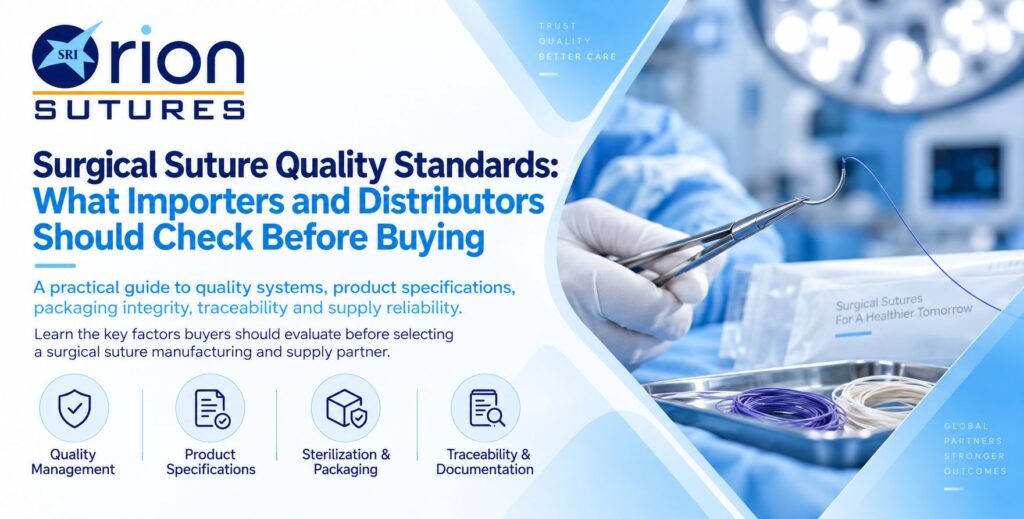
When purchasing surgical sutures in bulk, price should never be the only deciding factor. For importers, distributors, hospitals, and medical-device companies, the quality of a surgical suture directly affects product reliability, regulatory compliance, surgeon confidence, and ultimately patient safety. A reliable surgical suture manufacturer should therefore be evaluated on much more than product availability. Buyers need to assess manufacturing controls, raw materials, product performance, sterilization, packaging, documentation, regulatory readiness, and supply consistency before entering into a long-term partnership. Here are some of the most important factors importers and distributors should check before buying surgical sutures. 1. Check the Manufacturer’s Quality Management System The first step is evaluating whether the manufacturer operates under a structured quality management system appropriate for medical devices. ISO 13485 is an internationally recognized quality-management standard specifically developed for organizations involved in medical-device manufacturing. It focuses on areas such as controlled manufacturing processes, regulatory requirements, risk management, traceability, documentation, and consistent product quality. Importers and distributors should evaluate the manufacturer’s applicable certifications and regulatory documents according to the market where the products will eventually be sold. Documentation should always be checked for validity, scope, product coverage, and issuing authority rather than relying only on a certification logo shown in marketing material. 2. Verify Suture Material and Product Specifications Different surgical procedures require different types of sutures. Therefore, buyers should clearly understand the material and construction of each product being purchased. Common categories include: Absorbable sutures Non-absorbable sutures Monofilament sutures Multifilament or braided sutures Natural sutures Synthetic sutures Materials may include polypropylene, polyamide, polyester, silk, polydioxanone and other approved suture materials depending on the product and intended use. For example, FDA guidance for surgical sutures highlights the importance of clearly identifying suture materials, additives, coatings, size specifications, and other product characteristics. Importers should therefore request detailed technical specifications rather than evaluating a product solely from its commercial name. 3. Evaluate Tensile Strength Tensile strength is one of the most important performance parameters of a surgical suture. The suture must provide adequate mechanical strength for its intended application while maintaining appropriate performance during tissue healing. For buyers dealing in international markets, specifications may need to satisfy applicable pharmacopoeial, regulatory, or recognized standards. For example, current FDA-recognized standards for certain surgical sutures include requirements related to tensile strength, suture diameter, needle attachment and absorbable/non-absorbable suture specifications. A professional importer should therefore verify relevant test reports and product specifications for the particular type of suture being purchased. 4. Check Suture Diameter Consistency Uniform diameter is another important quality parameter. Variations in suture diameter can affect handling, knot performance and consistency during surgical use. Surgical sutures are normally manufactured according to defined size classifications, and the actual diameter should remain within the applicable specification for that size. When evaluating a supplier, distributors should ask how diameter consistency is controlled during production and whether appropriate inspection and testing procedures are followed. 5. Examine Needle Quality and Needle-Suture Attachment In an atraumatic surgical suture, the needle and suture work as a single system. The quality of the needle therefore deserves the same attention as the suture material itself. Buyers should evaluate characteristics such as: Needle sharpness Needle strength Surface finish Consistency of needle geometry Corrosion resistance where applicable Needle-to-suture attachment Appropriate needle type for intended procedures Poor needle attachment may compromise handling or product performance. Needle attachment is also among the performance areas covered by recognized standards referenced for surgical sutures in FDA device classifications. 6. Confirm Sterilization Controls Sterility is critical for sterile surgical sutures. Importers should understand the manufacturer’s validated sterilization process, packaging controls and applicable documentation. Depending on the product, manufacturer and regulatory market, different validated sterilization technologies may be used. Buyers should confirm that the sterilization process is appropriately controlled and documented and that product sterility can be maintained throughout its labelled shelf life when stored according to specified conditions. 7. Inspect Primary Packaging Quality Even a well-manufactured suture can become unsuitable if its sterile barrier or packaging integrity is compromised. High-quality packaging should protect the product from manufacturing release through transportation, storage and eventual clinical use. Buyers should examine: Seal integrity Packaging strength Product protection Ease of opening Clear identification Batch information Expiry information Storage instructions Sterile-barrier integrity where applicable Packaging becomes even more important for exporters because products may travel thousands of kilometres and remain in warehouses for extended periods. 8. Check Product Traceability Traceability is essential in medical-device supply chains. Each product should be traceable through appropriate batch or lot identification so manufacturers and distributors can identify affected products if a complaint, investigation, corrective action or recall is required. In the European Union, for example, medical-device regulations establish responsibilities for manufacturers, importers and distributors intended to support device safety and traceability across the supply chain. Importers should therefore evaluate how effectively a prospective supplier maintains manufacturing, testing and distribution records. 9. Review Labelling Carefully Correct labelling is particularly important for international distribution. Depending on the destination country and applicable regulation, labels may need to contain information such as: Product name Suture material Suture size Suture length Needle type and size Lot or batch number Manufacturing information Expiry date Sterilization status Storage requirements Required regulatory symbols Importers should confirm that labelling can satisfy the regulatory requirements of their intended destination market. 10. Ask for Technical and Regulatory Documentation Reliable manufacturers should be capable of supporting buyers with appropriate product and regulatory documentation where applicable. Depending on the product and country, importers may need documents relating to: Product specifications Quality certificates Certificates of analysis Sterilization documentation Technical documentation Test reports Regulatory registrations Manufacturing licences Product declarations Export documentation The exact documentation required differs by market. Therefore, before placing a large order, importers should identify the regulatory requirements of the destination country and ensure that the manufacturer can support them. 11. Assess Manufacturing Consistency, Not Just Samples One common mistake made by buyers is approving a supplier based only on a few good samples. The real challenge in surgical-suture manufacturing is maintaining consistent quality across thousands or millions of
What Distributors Should Check Before Buying Sutures Leer entrada »