

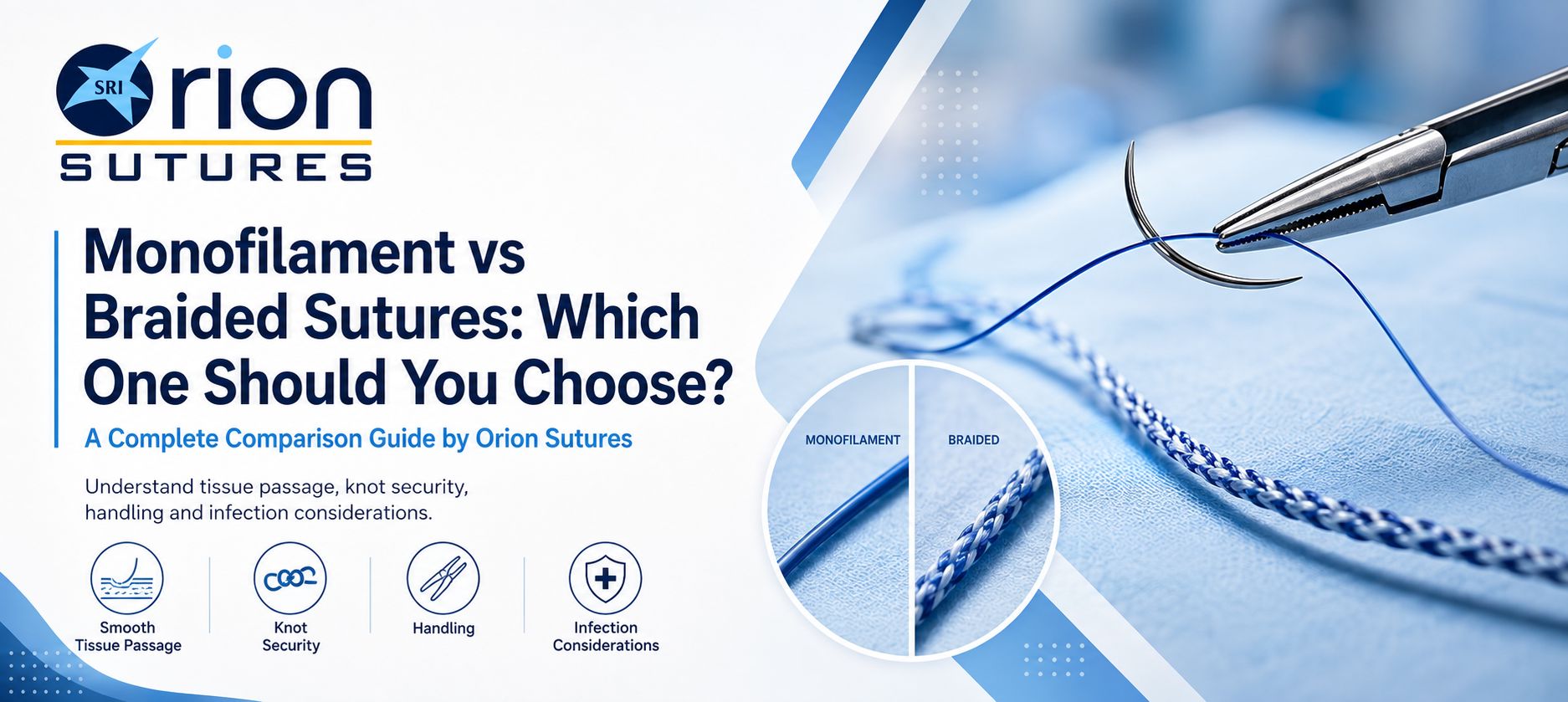
Choosing the appropriate surgical suture involves evaluating its material, absorption profile, size, needle type and physical construction. One of the most important distinctions is whether the suture is monofilament or braided.
The comparison between monofilament vs braided sutures is particularly important because their construction can influence tissue passage, handling, knot security and bacterial adherence.
Neither construction is universally suitable for every procedure. The final selection should depend on the tissue being repaired, wound environment, required support, surgical technique and the surgeon’s professional judgement.
This guide from Orion Sutures explains the major differences between monofilament and braided sutures to help healthcare professionals, hospitals, distributors and medical suppliers understand their respective characteristics.
What Are Monofilament Sutures?
A monofilament suture is manufactured from a single continuous strand of material.
Because it has a relatively smooth surface, a monofilament suture generally passes through tissue with less resistance than a multifilament construction. Its single-strand structure also provides fewer spaces in which fluid and microorganisms can be retained.
Common monofilament materials may include:
- Polipropileno
- Polyamide or nylon
- Polydioxanone
- Poliglecaprone
- Stainless steel
The exact handling and performance characteristics vary according to the polymer, diameter, manufacturing process and intended application.
What Are Braided Sutures?
Braided sutures are made from multiple fine filaments woven or braided together to form a single surgical thread.
This multifilament construction typically gives the suture greater flexibility and pliability. Braided sutures are often easier to handle and can provide reliable knot stability, although knot performance also depends on the material, technique and number of throws.
Common braided suture materials may include:
- Poliglactina 910
- Polyglycolic acid
- Poliéster
- Seda
Some braided sutures are coated to improve tissue passage and reduce surface friction.
Monofilament vs Braided Sutures: Quick Comparison
| Feature | Monofilament sutures | Braided sutures |
|---|---|---|
| Construction | Single continuous strand | Multiple woven filaments |
| Surface | Smooth | Textured or coated |
| Tissue passage | Generally lower resistance | May produce greater tissue drag |
| Handling | Can be firmer or retain memory | Usually soft and flexible |
| Knot security | May require careful knot technique | Often provides good knot stability |
| Bacterial adherence | Generally lower potential | Interstices may retain microorganisms |
| Common consideration | Delicate or contaminated environments | Procedures requiring flexible handling |
This comparison provides general guidance only. Individual products can perform differently depending on their material and coating.
Tissue Passage
Tissue passage refers to the way a surgical suture moves through tissue after the needle has created the initial pathway.
Monofilament sutures
The smooth, single-strand surface of a monofilament suture generally produces less friction during tissue passage. This can help reduce drag and unnecessary disruption of delicate tissues.
Monofilament sutures may therefore be considered where smooth passage and reduced tissue resistance are important.
However, their smooth surface can also make them more slippery during knot formation.
Braided sutures
The woven surface of a braided suture may create greater friction as it passes through tissue. This characteristic is sometimes described as tissue drag.
Coatings are often applied to braided sutures to improve glide and handling. Research also shows that frictional performance can vary significantly between different braided constructions and coatings, meaning the physical structure alone does not determine every aspect of performance.
The effect of tissue drag should therefore be evaluated alongside the required tensile strength, tissue type and surgical technique.
Knot Security
Knot security refers to the ability of a tied suture to maintain closure without slipping or becoming untied.
Braided suture knot security
The textured surface of braided sutures creates friction between the strands of the knot. This often helps the knot remain stable and can make braided materials easier to control during placement.
Their flexibility and pliability may also allow the surgeon to position and tighten the knot more comfortably.
Monofilament suture knot security
Monofilament sutures have a smoother surface and may exhibit greater memory, meaning the material may tend to return to its original packaged shape.
Because of this smoothness, some monofilament materials may require additional throws or careful knotting technique to achieve secure closure.
However, knot security cannot be predicted from construction alone. Mechanical research has shown that it depends on the specific suture material, knot type and number of throws used.
Surgeons should therefore follow the applicable product instructions and use a knotting technique appropriate for the selected material.
Handling and Flexibility
Handling describes how the suture behaves while it is held, passed, tightened and knotted.
Handling characteristics of braided sutures
Braided sutures are generally:
- Soft and flexible
- Easy to grasp
- Less likely to retain strong packaging memory
- Comfortable to manipulate
- Easier to position during knot formation
These characteristics can be useful in procedures where precise handling and repeated knot placement are required.
Handling characteristics of monofilament sutures
Monofilament sutures are generally:
- Smooth during tissue passage
- Less absorbent
- More resistant to harbouring fluids within the strand
- Firmer than many braided sutures
- More likely to demonstrate memory
The degree of stiffness varies considerably between materials. Some modern monofilament sutures are designed to provide improved flexibility while maintaining their smooth single-strand structure.
Infection and Bacterial Adherence Considerations
Surgical site infection is influenced by many factors, including wound contamination, tissue condition, surgical technique, sterilisation, patient health and postoperative care. Suture construction is only one part of this wider clinical assessment.
Braided sutures contain small spaces between their individual filaments. These interstices may retain fluid or microorganisms more readily than the smooth surface of a monofilament suture.
Laboratory research involving cervical cerclage materials found substantially greater Gardnerella biofilm formation on braided polyester sutures than on the monofilament sutures tested.
A retrospective study of oral oncological surgery with free-flap reconstruction also reported a higher surgical-site infection rate in the braided suture group than in the monofilament group. However, the findings relate to a specific procedure and should not be interpreted as proving that braided sutures are unsuitable for all surgeries.
Monofilament sutures may therefore be considered in contaminated or infection-sensitive environments, but the final decision should be based on the complete clinical situation.
Reacción tisular
Tissue response is influenced by several factors:
- Suture material
- Suture diameter
- Surface construction
- Absorption process
- Duration of implantation
- Tissue condition
- Presence of contamination
Some studies have observed a greater connective-tissue response around braided sutures than monofilament sutures because tissue can grow around and between the individual filaments.
However, tissue reaction varies between products. The chemical composition of the suture may be as important as whether it is monofilament or braided.
When May Monofilament Sutures Be Considered?
Depending on the specific product and professional clinical judgement, monofilament sutures may be considered when:
- Smooth tissue passage is important
- Lower tissue drag is preferred
- The surgical area has a higher contamination concern
- Reduced fluid retention is desirable
- Delicate tissue is being approximated
- Long-term support is required from an appropriate non-absorbable material
Their firmer handling and potential knot slippage must also be considered.
When May Braided Sutures Be Considered?
Braided sutures may be considered when:
- Flexible handling is important
- Strong knot stability is required
- The surgeon prefers a soft and pliable thread
- Precise control during knot placement is needed
- The surgical environment is clean and appropriate for multifilament use
- A suitable absorbable or non-absorbable braided material is indicated
The potential for greater tissue drag and bacterial retention should be assessed according to the procedure.
Factors to Consider Before Selecting a Suture
When comparing monofilament vs braided sutures, healthcare professionals should evaluate:
- Tissue type and density
- Condition of the wound
- Level of contamination
- Required duration of wound support
- Absorbable or non-absorbable requirement
- Suture diameter and tensile strength
- Needle type and curvature
- Knotting technique
- Handling preference
- Product-specific instructions
There is no single suture construction that provides every desirable characteristic. Selection requires balancing tissue passage, handling, knot security and wound-related considerations.
Orion Sutures: Supporting Diverse Surgical Requirements
Orion Sutures provides surgical suture solutions designed to support different wound-closure requirements across healthcare markets.
By offering suture options with different constructions, materials, sizes and performance characteristics, Orion Sutures supports hospitals, surgeons, distributors, importers and medical supply companies in selecting suitable products for their respective requirements.
The company focuses on delivering surgical suture solutions associated with consistent quality, dependable handling and secure wound-closure support.
Conclusión
The choice between monofilament and braided sutures should be made according to the tissue, wound environment, surgical procedure and required performance.
Monofilament sutures generally offer smoother tissue passage and fewer spaces for bacterial retention. Braided sutures generally provide greater flexibility, easier handling and dependable knot stability.
However, these are general characteristics rather than absolute rules. The material, coating, diameter, needle configuration and knotting technique can all affect the final performance of a suture.
For information about available monofilament and braided suture options, bulk procurement or distribution opportunities, contact Orion Sutures.
Frequently Asked Questions
What is the main difference between monofilament and braided sutures?
A monofilament suture consists of one continuous strand, while a braided suture is produced from multiple filaments woven together.
Which suture passes more smoothly through tissue?
Monofilament sutures generally pass through tissue with less resistance because of their smooth, single-strand surface.
Which type provides better knot security?
Braided sutures often provide good knot stability because of surface friction. However, knot security depends on the material, knotting technique and number of throws.
Are monofilament sutures better for infection-sensitive wounds?
Their smooth construction provides fewer spaces for retaining microorganisms. They may therefore be considered in infection-sensitive or contaminated environments, subject to clinical judgement.
Are braided sutures easier to handle?
Braided sutures are generally softer and more flexible, which often makes them easier to manipulate and knot.
Does Orion Sutures provide monofilament and braided suture solutions?
Orion Sutures supports varied surgical requirements through suture solutions with different constructions, materials, sizes and handling characteristics.
Medical disclaimer: This article is intended for general educational and product-awareness purposes. Suture selection should be made by qualified healthcare professionals according to the procedure, tissue requirements, product instructions and applicable clinical protocols.