

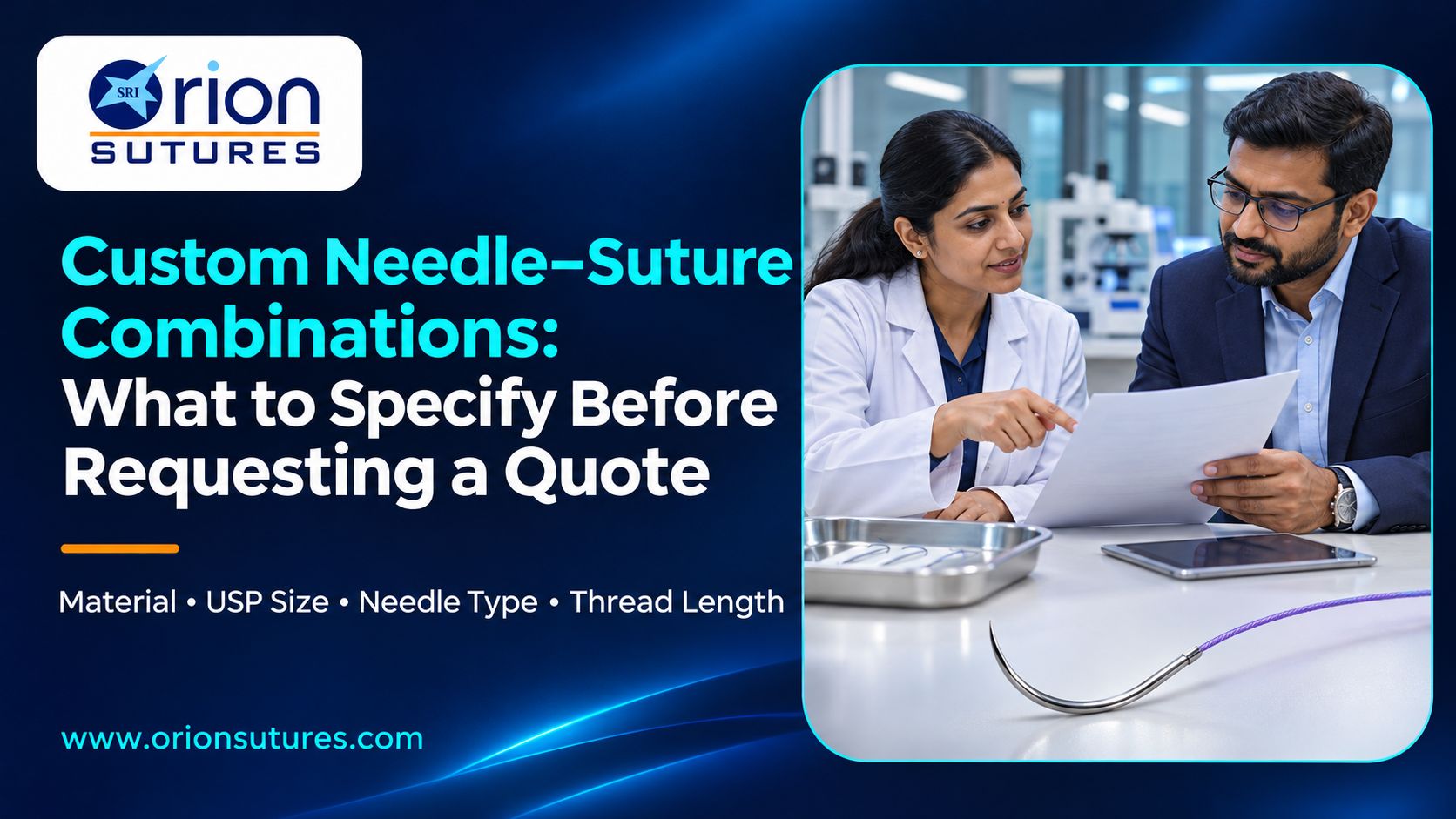
When sourcing surgical sutures, the material name alone is not enough to obtain an accurate quotation. Two products may use the same thread material but differ in needle length, curvature, point type, thread length or packaging.
For distributors, hospital suppliers and private-label buyers, a complete specification helps manufacturers assess availability, prepare comparable prices and identify requirements that need clarification.
Orion Sutures offers customised needle–suture combinations through its OEM and contract-manufacturing services. Preparing the following details before making an enquiry can help move the discussion forward.
1. Identify the Suture Material and Construction
Begin with the exact material required by your customer. Avoid broad descriptions such as “absorbable thread” or “non-absorbable suture.”
Specify the material, whether it is monofilament or multifilament, and any required coating or colour. Orion’s catalogue distinguishes products by material, construction and dyed or undyed presentation.
If you are sourcing an alternative to an existing product, provide its label, catalogue reference or specification sheet. Ask the manufacturer to identify any differences rather than assuming a direct replacement.
2. State the USP Size and Thread Length Separately
The USP size describes the suture strand’s diameter classification. It does not describe the needle size.
Record the required USP size and thread length as separate fields, with clear units. Also identify whether the pack needs one strand or multiple strands. Manufacturer catalogues list these characteristics separately because they describe different parts of the product configuration.
Write quantities clearly. For example, “one 75 cm strand per pouch” communicates more information than “75 cm suture.”
3. Describe the Needle Beyond Its Code
A needle code is a useful reference, but your enquiry should also contain a written description.
Include:
- Needle length in millimetres.
- Curvature, such as 3/8 circle or 1/2 circle.
- Point type, such as taper point, cutting or reverse cutting.
- Any specified needle-body or wire characteristics.
- A catalogue reference or drawing, where available.
Needle length, curvature and wire thickness are separate characteristics. A complete description helps avoid confusion when comparing products from different manufacturers.
The requested combination should reflect the healthcare professional’s requirements and the product’s intended use.
4. Confirm the Needle Attachment Configuration
Specify whether you require a single-armed or double-armed suture. A double-armed configuration has a needle attached to each end of the strand.
For double-armed products, describe both needles. If the customer requires different needles at opposite ends, state each specification explicitly.
Where a specialised attachment or presentation is requested, ask the manufacturer to confirm feasibility and availability before treating it as an agreed configuration.
5. Define Packaging and Brand Requirements
Packaging requirements should be included in the initial enquiry, particularly for private-label projects.
Clarify whether you need the manufacturer’s branding, neutral packaging or your own brand presentation. State the number of sutures per pouch, pouches per box and any required language or artwork arrangements.
Orion Sutures lists private-label manufacturing, artwork assistance and customised packaging among its OEM services. These requirements should be discussed alongside the product configuration so the quotation reflects the proposed supply.
Also confirm the required sterile presentation, storage information and remaining shelf life at dispatch.
6. Provide Quantities for Each Configuration
A total order quantity does not explain how that volume is divided between products.
List the opening quantity for every needle–suture combination and provide an estimated repeat-order requirement where possible. Ask whether minimum quantities apply separately to each configuration or packaging version.
Distinguish between sample quantities, an initial commercial order and anticipated recurring purchases. This helps both parties discuss production planning without treating a forecast as a confirmed commitment.
7. Share Destination and Delivery Requirements
Include the destination country, delivery location and preferred delivery terms. State whether the quotation should include freight or cover collection from the manufacturer.
Ask which documents are available for the selected products and discuss any destination-specific requirements with your local regulatory representative.
If the order is linked to a tender or launch date, provide the deadline and clarify when specifications, artwork and other approvals will be finalised.
8. Use a Consistent Quotation Request Format
A simple specification table makes multiple configurations easier to review.
| Field | Information to provide |
|---|---|
| Buyer reference | Your item number or tender reference |
| Sutura | Material, construction, coating and colour |
| Strand specification | USP size, length and strands per pouch |
| Needle | Point type, curvature and length |
| Attachment | Single-armed, double-armed or specified configuration |
| Embalaje | Pouches per box and branding requirements |
| Quantity | Opening order and estimated repeat demand |
| Delivery | Destination, preferred terms and required date |
Before ordering, compare the quotation against this table. Confirm any proposed substitutions in writing and keep the approved specification linked to the final product code.
Request a Custom Suture Quotation From Orion Sutures
Orion Sutures supports OEM and private-label enquiries involving customised needle–suture combinations, packaging, artwork and documentation assistance. Availability and project terms should be confirmed for the specific requirements.
Share your specification sheet, quantities and destination through Orion Sutures’ OEM Services to discuss your requirements and request a quotation.